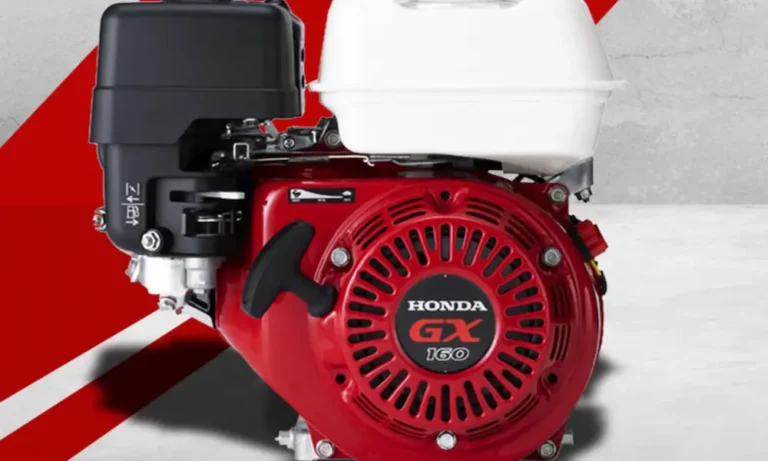
The Honda GX160 oil capacity is one of those specs that sounds simple until you get it wrong. Too little oil and the engine seizes. Too much and you’ve got foaming, pressure buildup, and a leaking breather. This guide covers the exact numbers, the right oil to use, and a maintenance schedule that keeps this tough little engine running for thousands of hours. Stick around — the reduction gearbox section alone will save you a headache.
What Is the Honda GX160 Oil Capacity?
The Honda GX160 oil capacity is 0.58 liters (0.61 US quarts, or about 19.6 oz). Some regional documentation rounds this up to 0.6 liters, but stick to 0.58 L as your target.
That 20 ml difference matters more than you’d think. Overfilling can increase crankcase pressure and push oil through the breather system. Underfilling starves the splash lubrication system, and that’s when bearings and cylinder walls start suffering.
How the GX160 Lubrication System Works
The GX160 doesn’t use a pressurized oil pump. Instead, it runs a splash lubrication system — a dipper on the connecting rod’s big-end cap literally slaps the oil in the sump on every crank rotation, flinging a fine mist across the cylinder walls, piston pin, camshaft, and governor assembly.
That’s why the oil level is everything. If the sump’s too low, the dipper misses the oil. The mist stops. The engine starts dying from the inside out — quietly, with no warning until it’s too late.
GX160 vs. the GX Family: Oil Capacity Comparison
If you manage multiple engines, don’t assume one size fits all. Here’s how the GX engine family compares:
| Engine Model | Oil Capacity (Liters) | Oil Capacity (US Quarts) | Oil Capacity (Ounces) |
|---|---|---|---|
| Honda GX120 | 0.56 L | 0.59 US qt | 18.9 oz |
| Honda GX160 | 0.58 L | 0.61 US qt | 19.6 oz |
| Honda GX200 | 0.60 L | 0.63 US qt | 20.3 oz |
The differences look tiny on paper. But pour GX200 quantities into a GX160 consistently and you’ll deal with oil foaming and breather issues. Use GX120 quantities and the splash system won’t reach optimum coverage.
Reduction Gearbox Oil Capacity: Don’t Forget These
Here’s where most people trip up. The GX160 often mounts to a reduction gearbox, and that gearbox has its own separate oil supply. Neglect it, and you’ll destroy a gearbox that works harder than the engine itself.
2:1 Reduction Case with Centrifugal Clutch (L-Type)
Common in go-karts and heavy-duty mixer applications. This unit doubles torque and cuts output speed in half.
- Capacity: 0.50 liters (500 ml / 0.53 US qt)
- Oil type: SAE 10W-30, same as the engine
- Check method: Use the dedicated dipstick on the reduction case — insert it but don’t screw it in for an accurate reading
6:1 Reduction Case (H-Type)
This one’s built for extreme torque, low-speed applications. Thermal stress on the oil here can be intense. If you’re running one of these, check the specs before every job.
- Capacity: 0.15 liters (150 ml / 0.16 US qt)
- Check method: Remove the oil-level check bolt with the engine level — oil should sit right at the edge of the bolt hole
- Drain method: Remove both filler and check bolts, then tip the engine toward the check bolt hole
2:1 Reduction Case without Clutch (R-Type)
The compact version, used in specialized configs.
- Capacity: Just 0.06 liters (60 ml / 2.0 US oz)
- Important: That tiny reservoir means a minor leak can cause a dry-running failure within a single shift
| Reduction Type | Ratio | Oil Capacity | Check Method |
|---|---|---|---|
| Centrifugal Clutch | 2:1 | 0.50 L | Dipstick (not screwed in) |
| Standard Gear | 6:1 | 0.15 L | Edge of check bolt hole |
| Compact Gear | 2:1 | 0.06 L | Edge of filler hole |
Which Oil Should You Use in the Honda GX160?
Honda specifies premium-grade detergent oil for the GX160. Non-detergent oil is a no-go. Because the GX160 doesn’t have an oil filter, detergent additives do the job of keeping combustion byproducts suspended until you drain them at the next oil change.
API Classification
- Minimum: API Service SE (or later: SF, SG, SH, SJ, SL, SM, SN)
- Recommended: API Service SJ or later for the modern UT2 series
Viscosity by Temperature
| Condition | Recommended Viscosity |
|---|---|
| General use (most climates) | SAE 10W-30 |
| Cold weather (below -15°C / 5°F) | SAE 5W-30 |
| Extreme heat (above 30°C / 86°F) | SAE 30 (limited cold-start protection) |
SAE 10W-30 covers most situations without needing to overthink it. If you’re running the engine in cold climates — like powering a snow blower or winter pump — go with 5W-30 to guarantee immediate lubrication on startup.
Can You Use Synthetic Oil?
Yes. Honda permits synthetic oil as long as it meets the same API and SAE ratings. Synthetic offers real advantages for industrial use:
- Better oxidative stability — it handles the intense heat of continuous-duty air-cooled engines without breaking down as fast
- Better shear stability — it maintains viscosity under the mechanical forces inside reduction gears and the valve train
- Cleaner operation — synthetic molecules stay more uniform and resist sludge formation
One important note: synthetic oil doesn’t change your maintenance intervals. The engine still accumulates metallic particulates from normal wear, and those need draining on schedule regardless of oil type.
Honda GX160 Maintenance Schedule
The official maintenance information lays out a clear schedule. Follow it exactly for the first 20 hours — that break-in period releases more metallic debris than any other phase of the engine’s life.
| Interval | Task |
|---|---|
| Every use | Check engine oil level |
| Every use | Check reduction case oil level |
| First 20 hours / 1 month | Change engine oil AND reduction case oil |
| Every 100 hours / 6 months | Change engine oil AND reduction case oil |
| Every 100 hours / 6 months | Clean sediment cup |
| Every 300 hours / 1 year | Check and adjust valve clearance |
| Every 300 hours / 1 year | Replace spark plug |
Working in dusty environments — construction sites, agricultural fields? Cut that 100-hour interval to 50 hours. Fine particulates bypass air filters and contaminate the crankcase faster than most people expect.
How to Change the Oil Correctly
Draining
- Warm the engine first — run it a few minutes so the oil thins out and contaminants stay suspended
- Level the equipment — the engine needs to sit flat so all oil reaches the drain plug
- Remove the drain bolt and washer — reinstall torqued to 2.4 kgf·m (about 18 lb-ft)
- Check the washer — a flattened washer is the most common source of slow leaks that sneak up on you
Refilling
- Pour in your 10W-30 slowly through the filler neck
- Insert the dipstick without screwing it in — oil should read at the upper limit mark
- Start the engine, run it for a minute, then shut it off and check for seepage at the drain bolt and filler cap
The Oil Alert System: What It Does (and What It Doesn’t)
Many GX160 engines include Honda’s Oil Alert system — a float switch in the crankcase that grounds the ignition coil when oil drops too low. No spark. Engine stops. Simple and effective.
The most common troubleshooting mistake? Assuming there’s an ignition or fuel problem when the Oil Alert is doing exactly what it’s designed to do.
But here’s the catch: the Oil Alert triggers at the threshold of just enough oil to prevent immediate seizure. It’s not a substitute for regular checks. Running consistently near that threshold still stresses the valve train and cylinder walls over time.
What Happens When You Neglect the Oil
Poor lubrication doesn’t just affect the crankcase. It ripples into every system.
Valve train: The valves in the GX160’s cylinder head rely entirely on oil mist from the splash system. Low or degraded oil means:
- Increased valve stem friction in the guides
- Valve clearances that drift as parts overheat and expand, eventually causing compression loss
Governor: The centrifugal governor that holds the engine at 3,600 rpm under load is also splash-lubricated. Sludge from old oil causes governor hunting (surging) or sluggish load response — which can damage whatever equipment the engine is powering.
Quick Reference: All the Key Numbers
| Specification | Value |
|---|---|
| Engine oil capacity | 0.58 L / 0.61 US qt |
| Reduction case (2:1 w/ clutch) | 0.50 L / 0.53 US qt |
| Reduction case (6:1) | 0.15 L / 0.16 US qt |
| Reduction case (2:1 compact) | 0.06 L / 2.0 US oz |
| Oil bath air cleaner | 0.06 L / 2.0 US oz |
| Primary oil type | SAE 10W-30, API SJ or later |
| First oil change | 20 hours or 1 month |
| Regular oil change | Every 100 hours or 6 months |
| Dusty environments | Every 50 hours |
Keep these numbers taped to whatever equipment runs the GX160. It takes 30 seconds to check the oil before every job. That 30 seconds is the difference between an engine that runs for 3,000 hours and one that seizes at 400.