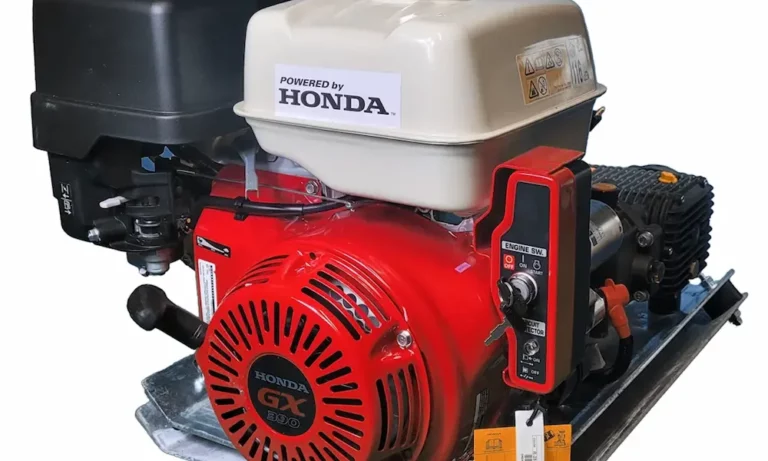
Got a Honda GX390 and not sure how much oil to put in? You’re about to find out — fast. Whether you’re doing your first oil change or just double-checking the spec, this guide covers the exact oil capacity, the right oil to use, how to check it properly, and what happens if you get it wrong. Stick around, because the last section could save your engine.
The Honda GX390 Oil Capacity (The Short Answer)
The Honda GX390 oil capacity is 1.1 liters — that’s the standard for the K1, T2, and UT2 series engines.
Here’s what that looks like in different units:
| Measurement | Capacity |
|---|---|
| Liters | 1.1 L |
| US Quarts | 1.16 qt |
| Imperial Quarts | 0.97 qt |
| Cubic Centimeters | 1,100 cc |
You might see 1.2 US quarts listed in some distributor specs. That’s usually for a dry fill — when the engine is brand new or freshly rebuilt and needs a little extra to saturate all the internal surfaces.
For a regular oil change? Stick with 1.1 liters.
How to Check the Oil Level the Right Way
This part trips people up more than you’d think. The GX390 uses its oil filler cap as a dipstick, and there’s a specific way to read it correctly.
Here’s the process straight from Honda’s owner’s manual:
- Put the engine on a perfectly level surface — any tilt throws off the reading
- Turn the engine OFF and let it sit for a minute
- Remove the oil filler cap/dipstick and wipe it clean
- Insert it back into the filler neck — don’t screw it in
- Pull it out and check where the oil line sits
If you screw the cap in, you’ll get a falsely high reading. That means you might think you’ve got enough oil when you don’t — and that’s a quick way to cook the engine.
The oil level should sit at the upper edge of the filler neck or at the dipstick’s upper mark.
What Oil Does the Honda GX390 Take?
The Honda GX390 maintenance guide recommends SAE 10W-30 as the go-to for most conditions. It needs to meet API SJ or later classification — that’s the chemical quality standard that ensures proper engine protection.
Use this table to match your oil to the conditions you’re working in:
| Temperature Range | Recommended Viscosity |
|---|---|
| General / All-season use | SAE 10W-30 |
| Hot climates or heavy-duty use | SAE 10W-40 |
| Sub-freezing temperatures | SAE 5W-30 |
| Warm to hot conditions only | SAE 30 |
If you’re running this engine hard — think power buggies, commercial construction equipment, or anything baking in the sun all day — 10W-40 gives you a stronger oil film at high operating temps.
Synthetic oil is fine, but it doesn’t change how often you need to change it. Same intervals apply.
What’s in the oil that matters?
Quality oil for the GX390 needs these additives:
- Detergents and dispersants — keep carbon deposits from turning into sludge
- Anti-wear agents (like ZDDP) — protect the camshaft lobes and valve rockers
- Anti-foaming agents — critical for a splash-lubricated engine like this one
- Corrosion inhibitors — protect the internals during storage
How the GX390 Lubrication System Actually Works
The GX390 uses a forced splash lubrication system. There’s no oil pump. Instead, a small dipper on the connecting rod dips into the oil sump as the crankshaft rotates. It flings oil around the inside of the engine, coating the cylinder walls, piston pin, camshaft, and valve train.
This system works — but only if the oil level is right.
Too little oil: The dipper can’t reach the sump. Metal surfaces run dry, heat builds fast, and the aluminum piston expands inside the cylinder sleeve. That’s engine damage happening in real time.
Too much oil: The dipper whips air into the oil and creates foam. Foam can’t protect metal surfaces the way liquid oil can. Overfilling also forces oil into the breather system and into the carburetor — you’ll see oil in the air filter and have a hard time starting.
Also worth knowing: don’t tilt the engine more than 20 degrees during operation. Tilt it past that and the oil pools in one corner of the crankcase, moving it out of the dipper’s reach — even if you’ve got the full 1.1 liters in there.
Oil Capacity for GX390 Reduction Gear Options
If your GX390 runs a gearbox, that unit has its own separate oil system — don’t confuse it with the engine crankcase.
| Reduction Type | Oil Capacity (Metric) | Oil Capacity (US) |
|---|---|---|
| 1/2 reduction with centrifugal clutch | 0.3 L | ~10 oz |
| 2:1 gear reduction | 0.50 L | 0.53 qt |
| 6:1 gear reduction | 0.15 L | 0.16 qt |
The 1/2 reduction unit uses the same SAE 10W-30 you put in the engine. The 6:1 reduction uses helical gears that put serious stress on the oil film — so don’t skip maintenance on that one.
The Oil Alert System: Your Engine’s Last Line of Defense
Most GX390 engines come with Honda’s Oil Alert system built in. It’s a float sensor in the crankcase that monitors oil level. If the oil drops too low, it grounds the ignition and shuts the engine down — or prevents it from starting at all.
This is a backup, not a substitute for checking your oil manually. If your GX390 suddenly won’t start, check the oil level before you start chasing ignition or fuel problems.
Oil Change Schedule You Should Actually Follow
| Service Event | Interval |
|---|---|
| First oil change (break-in) | After 20 hours or 1 month |
| Regular oil changes | Every 100 hours or 6 months |
| Heavy-duty / dirty conditions | Every 50 hours or 3 months |
| Reduction gear oil change | Every 300 hours or 1 year (after initial 20-hour change) |
The first 20-hour oil change is non-negotiable. During break-in, the piston rings seat against the cylinder sleeve and release tiny metal particles into the oil. Leave that oil in and those particles act like grinding compound on your crankshaft journals and connecting rod bearings.
Skip it once and you’ve shortened the engine’s lifespan. It’s that straightforward.
How to Do a Proper Oil Change
- Warm the engine up first — run it for a few minutes. Warm oil flows out faster and carries contaminants with it
- Drain completely — remove the filler cap first, then the drain bolt and sealing washer
- Reinstall the drain bolt with a new sealing washer — torque it to spec
- Refill with exactly 1.1 liters of fresh SAE 10W-30 meeting API SJ or later
- Dispose of old oil properly — seal it in a container and take it to a certified recycling center
GX390 vs. Other GX Engines: How the Oil Capacity Compares
Here’s something interesting — the GX270, GX340, and GX390 all share the same oil capacity despite having different displacements.
| Engine | Displacement | Power (HP) | Oil Capacity |
|---|---|---|---|
| GX270 | 270 cc | 8.4 | 1.1 L |
| GX340 | 337 cc | 10.7 | 1.1 L |
| GX390 | 389 cc | 11.7 | 1.1 L |
| iGX390 | 389 cc | 11.7 | 1.1 L |
Honda’s modular crankcase design uses the same oil volume across these engines. But the GX390 runs hotter and harder than the GX270 — so the same 1.1 liters is under more thermal stress, which is exactly why the 100-hour change interval matters more here.
Warning Signs Your Oil Situation Is Off
Signs of low oil or oil starvation:
- White or blue smoke from the exhaust
- Engine suddenly seizes or locks up
- Unusual knocking or excessive vibration
Signs of overfilling:
- Oil in or around the air filter housing
- Engine bogs or smokes on startup
- Visible oil leaks around the crankshaft seals
Signs your oil is overdue:
- Oil looks dark and gritty on the dipstick
- Engine runs rough or feels louder than usual
- You can’t remember the last time you changed it (change it now)
The Honda GX390 technical spec sheet lists tight tolerances throughout the engine. The crankshaft journal and connecting rod clearances are measured in thousandths of a millimeter — and dirty, degraded oil is the fastest way to push those clearances past the service limit.
Keep the oil clean, keep it at 1.1 liters, and this engine will run for thousands of hours without complaint.